How CitedSEO checks facts and sources
Every fact in an article comes from a page CitedSEO read and kept, and is checked against that page before the article can go live.
Written By Damian
Last updated About 2 hours ago
Every fact in an article CitedSEO writes comes from a page its research read and kept, with a quote in that page's own words. Before the article can go live, each claim is checked against its quote and the part of the page around it, and every statistic needs a link to its source. A claim nothing backs is looked up once more, then taken out. An article with a claim that still fails is never published.
Where the facts come from
When CitedSEO researches a search, it reads up to 10 pages and keeps each one as it was read. It prefers sources in this order:
- Your own pages.
- Official sources: a government, a standards body, or a maker writing about its own product.
- Research.
- Publishers.
- Companies writing about the subject in general.
- Forums.
It never takes facts from your competitors' pages. Each fact it keeps has a quote from its page. A fact whose quote isn't on the page, or doesn't say what the fact says, is dropped before the writer sees it. A fact from one of your own pages is used only while that page is the same as when it was read.
When sources disagree on a date, number or price, the writer states the one an official source gives, else the one most sources give, else the most recent. It never states both.
How each claim is checked
- What needs a source. A separate reader goes through the finished draft and lists every sentence a reader could check: a figure, a date, what a named source said, how a product or law works. Advice, steps, your own views and what you offer don't need one.
- Read against its source. Each claim is read beside its quote and the part of the page the quote sits in. A claim the writer gave no fact for is read against the kept passages that share the most with it.
- Two readers. A fast reader checks every claim. Anything it's unsure of, or fails, goes to a second, stronger reader. A claim fails only when both fail it.
- Statistics. A figure someone measured or counted needs a link to its source in its own sentence, or its own table cell. A shared list of sources at the end doesn't count for it.
- Examples. The writer can write a sample email or an invented case to show how something works. It's checked that it reads clearly as an example, not as a fact about the real world.
When nothing backs a claim
Before the first round of fixes, CitedSEO searches once for a source for each claim nothing backs. If it finds one, the claim is tied to that new fact and checked against its quote. If it doesn't, the claim is taken out cleanly: never a step of a numbered list or a sentence the next one leans on.
If a claim still fails and can't be taken out, the article is marked Stopped at its checks and waits in Needs you. Nothing goes live.
Where you see it
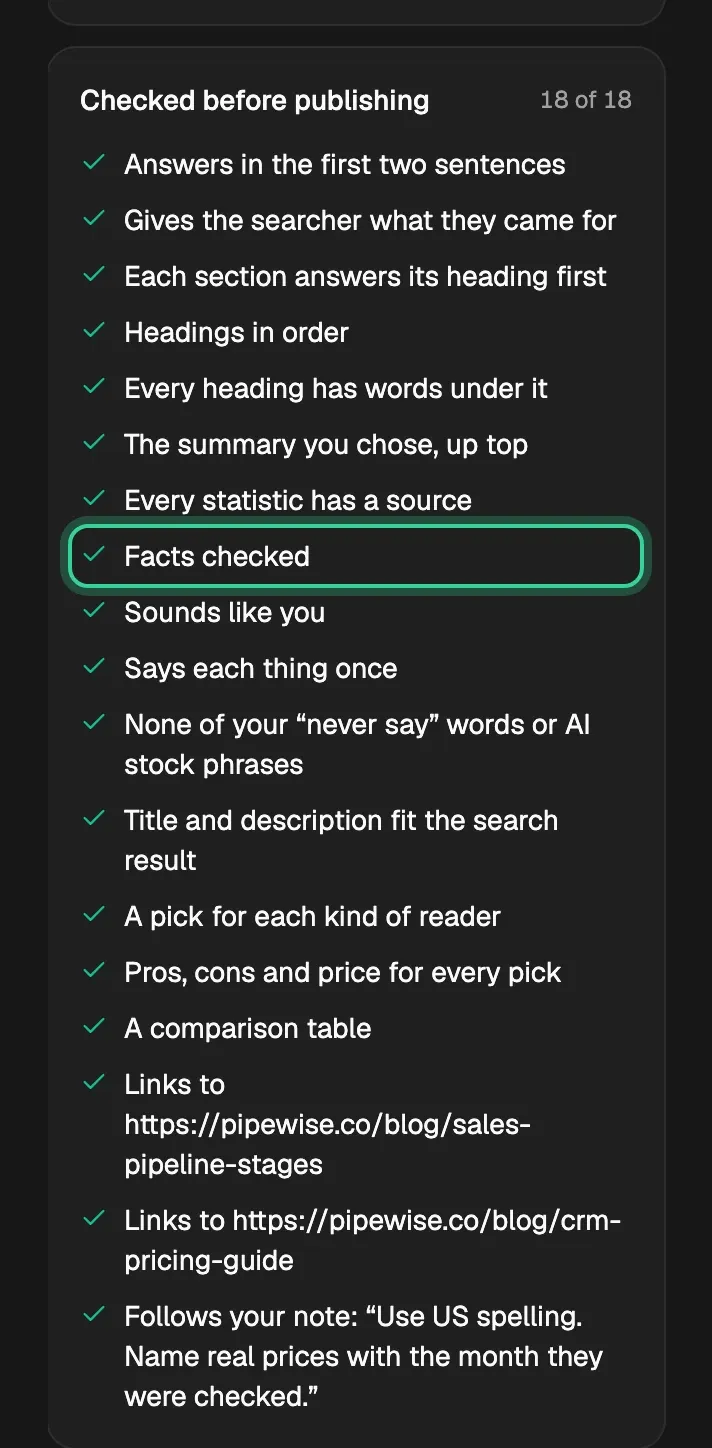
On the article page, Checked before publishing lists Facts checked and Every statistic has a source with every other check. Hover a check to see what was found.
With Sources switched on in Settings › Articles, the article ends with a Sources list: each page on another site that a claim rests on, once.
Related
Was this helpful?
Still need help? Share an idea